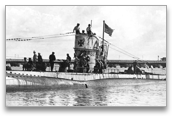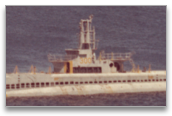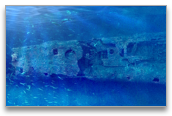
(Left) German U-boat UB 88 at the Brooklyn Navy Yard shortly after crossing the Atlantic from Harwich, England in 1919. Photo from the Naval Historical Center. (Right) UB 88 as she looked in 2004 after more than 80 years on the bottom of the Catalina Channel off of Long Beach, California. Photo by Kendall Raine.
Search and Discovery
On July 9, 2003, a group of explorers achieved a goal
sought for many years; discovery of the last resting place
of the only German U-boat on the West Coast of the United
States, the UB 88. The wreck was located after an
exhaustive year-long search effort. A cursory assessment of
the wreck was done using a tethered video camera and
recording sonar. On August 27, 2003, scuba divers visited
that resting place and brought back with them definitive
photographic evidence of the identity of the submarine.
This website is a historical and photographic record of the
life, death and rediscovery of the UB 88.
UB 88 served ten months in the Imperial German Navy and
sank 13 allied ships. After 20 months under special
commission in the U. S. Navy, UB 88 dove for the last time
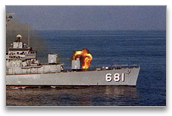
on January 3, 1921 under the guns of the USS Wickes. For 80
years, UB 88 lay intact, upright and near her designed
operating depth limit, undisturbed and undiscovered on the
sandy bottom south of the Port of Long Beach, California.
Despite knowledge of the UB 88’s existence from Navy
action and press reports, the location of the UB 88
remained a topic of much debate within the small and
furtive wreck diving community. Rumors surfaced
periodically about the wreck having been found, or someone
having coordinates for the sunken submarine. However, no
proof of her discovery emerged until now.
UB 88 Underway in the Florida Keys, 1919
In the U.S. Navy
UB 88 was one of six U-boats handed over to the United
States by Great Britain after the surrender of the German
High Seas Fleet. This small group of U-boats, dubbed
“The Ex-German Submarine Expeditionary Force”
had a dual mission: educate the U. S. Navy about
technological innovations achieved by the Imperial Navy in
submarine development and serve as a publicity vehicle for
the U. S. Government’s efforts to fund its war
deficit through the issuance of Victory Bonds. During the
trip from Harwich, England, to her final arrival at the
submarine base in San Pedro, California, she and her crew
made calls to ports along the Atlantic coast, Gulf of
Mexico, Mississippi River, coast of Panama and the West
coast, “steaming” a total of 15,361 miles.
Forty-five cities were visited, and over 400,000 visitors
were shown through the boat. She was laid up for the next
four months before being dismantled and decommissioned.
Having concluded her mission, UB 88 was sunk by the U.S.
Navy in a live fire exercise.